The situation
This client came to us needing a stronger foundation for how AI tools and search engines understood, ranked, and cited their site. Our progress in the early months was foundational rather than flashy: a full SEO audit, a measurement plan, analytics infrastructure, canonical tag mapping, structured data implementation, keyword and content strategy. While this admittedly isn't the most exciting work, it lays groundwork that everything else builds on.
That groundwork paid off steadily, month over month. Search visibility, AI citation presence, and organic traffic all climbed through the winter and spring. Partway through the engagement, this client underwent a full domain migration. Let's dive in to how it all turned out.
Foundational, not flashy. The early groundwork is what everything else builds on.
What we did
Full technical SEO audit and structured data implementation across the site
Analytics infrastructure build-out: measurement plan, tracking implementation, custom tagging and dashboards
Keyword research, keyword mapping, and an AEO-focused content strategy and editorial calendar
Content briefs and optimization recommendations for new and existing pages
An LLM visibility audit analyzing how this client was represented across major AI models, with an LLM playbook outlining actionable recommendations
AI prompt tracking across a curated set of prompts relevant to this client's content strategy
CRO testing and webinar/landing page optimization recommendations
Technical guidance and hands-on support through this client's domain migration, including staging review, search engine resubmission, and post-launch monitoring
The results
Traffic climbed, rankings jumped, leads more than doubled.
Organic traffic has grown steadily across the entire engagement
Comparing the full engagement to date (Nov 2025–Aug 2026) to the same window one year prior: organic sessions are up 69.6% (20,000 → 33,917) and engaged sessions are up 73.9% (11,270 → 19,599). This is nearly a full year of data, and it includes the domain migration, not just the period before it. The growth was already well underway before the migration happened, and it’s continued since.
Organic Growth, Full Engagement to Date (Nov 2025–Aug 2026)
Nov 2024–Aug 2025 (prior year)
Nov 2025–Aug 2026 (engagement)
Source: GA4, Traffic Acquisition report, Organic Search channel. Nov 1, 2025–Aug 31, 2026 vs. Nov 1, 2024–Aug 31, 2025. Spans the full engagement to date, including the domain migration.
Search rankings improved significantly
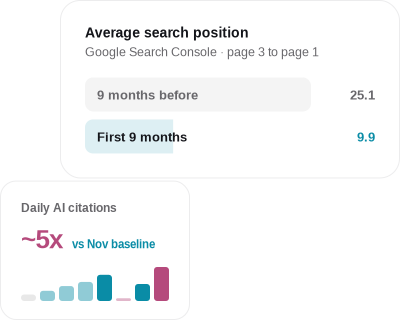
Per Google Search Console, comparing the 9 months before the engagement to the first 9 months of the engagement: average position improved from 25.1 to 9.9; roughly page 3 to page 1. Clicks up 31%, impressions up 30%.
AI citation visibility grew for months, dipped during the migration, and has since climbed to a new high
We’ve now tracked AI citation activity via Bing (first-party data on Copilot and partner surfaces) continuously from November through early September (before, during, and well after the migration). Average daily citations climbed steadily for seven months, from 28/day in November to a pre-migration peak of 114/day in late May/early June. The migration (mid-June) caused a sharp, temporary drop, bottoming out near 2/day during the transition. In the roughly three months since, citations have climbed to a new all-time high of ~148/day, nearly 5x the November baseline.
AI Citation Growth Through a Domain Migration
Source: Bing Webmaster Tools, first-party citation data. Weekly averages, Nov 1, 2025–Sep 9, 2026 (both domains combined).
AI-referred traffic shows the same growth arc, with a longer dip and a strong rebound
Real sessions referred from AI platforms (via GA4 referral tracking) follow a similar shape to the citation data, just on a slightly different timeline: sessions climbed from 94/month in January to a peak of 172 in May, then fell through June and bottomed out at 75 in July before rebounding to 145 in August, still short of the May peak but a strong recovery. Zoomed out, the trend is clearly upward: AI-referred sessions have averaged ~107/month across the engagement to date (Nov 2025–Aug 2026), roughly 50% higher than the ~72/month baseline in the seven months before the engagement began (Apr–Oct 2025).
AI-Referred Sessions Over Time
Source: GA4, sessions referred from AI platforms. Monthly totals, Apr 2025–Aug 2026.
Organic leads more than doubled, and AI-referred emerged as a new channel
Organic and AI-referred CRM lead data for this client shows a climb from ~10.5 leads per month to ~22.4/month, a 113% increase (engagement period vs previous period). Two of the three strongest months in this multi-year dataset (July 2026 and August 2026) land right after the pre-migration citation peak, running through the migration and the client’s seasonally weak month of August.
“AI Referrals” also barely existed as a lead source before this engagement. In the three-plus years of data prior to September 2025, there were only two AI-referred leads total. Since September 2025, it’s become a small but consistent channel every month.
Organic + AI-Referred Leads Over Time
Organic Search
AI Referrals
Source: HubSpot, Original Traffic Source = Organic Search + AI Referrals. Monthly totals, Nov 2024–Aug 2026.
Early CRO testing points toward stronger conversion messaging
We also ran an A/B test focused on new primary CTAs. Results showed an 11% lift in combined click-through rate on the new CTA pairing. We’ve implemented the stronger-performing CTA now, and are continuing to test other elements.
Why this matters
Long-term mindset. Every time.
We’re big believers in the idea that you should always, always, always approach search visibility with a long-term mindset. We don’t buy into hacks and ways to game the system short-term. They never work.
Instead, lay the groundwork, do the boring stuff, and stay consistent, and it will pay off.
