The situation
This client is a financial services firm we've supported for years, first through a long-term SEO engagement that built a deep library of educational content, strong author credibility, and a reputation as one of the more trusted voices in a competitive, trust-sensitive niche.
That foundation was strengthened further as the firm invested seriously in its own presence over many years, consistently publishing original content, public speaking, media appearances, and a steady stream of strong customer reviews.
In early 2026, we started a fresh AI visibility-focused engagement, and ran a structured LLM visibility audit analyzing how the firm was perceived and surfaced across major AI platforms. The findings showed the firm scored highly in its competitive set for trust and credibility, ahead of several much larger, better-known competitors.
But share of voice (how often the firm actually got surfaced in AI-generated answers) was consistently in the low single digits across every platform tested, in some cases well under 1%.
High perception, low discoverability. This gap is what we targeted with our content strategy.
What we did
Throughout 2026, our work spanned the full breadth of an active SEO/AEO engagement: ongoing technical and on-page optimization, new evergreen pillar content, editorial standards and E-E-A-T strengthening, mobile usability improvements, content architecture and internal linking, and active execution on a YouTube visibility strategy.
This case study focuses on one specific chapter: the LLM visibility audit and the site relaunch built around its findings.
Codified the brand narrative
Every AI model could describe the firm's individual products, but none could articulate a single, coherent philosophy behind them. We developed one core organizing thesis and threaded it through every page and product line.
Built a "category trade-offs" framework
Every AI model surfaced the same category-level friction points as negatives, not specific to this firm. We built a practical, plain-spoken resource addressing them directly, positioning the firm as the educator rather than a firm with something to hide.
Created audience-specific decision frameworks
The audit uncovered a gap between "people trust this firm's thinking" and "here's exactly how I'd act on it." We built distinct frameworks mapped to specific audience segments.
Shipped alongside a full site relaunch: a shift toward Q&A-style article formats, content structured explicitly around the way people search and ask questions to AI tools, rather than traditional SEO-first copy.
The results
Citations climbed, traffic converted better, new leads grew.
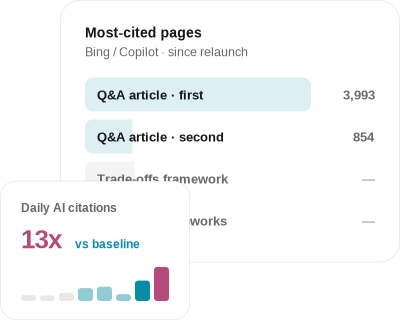
AI citation volume grew 13x, and the site relaunch barely slowed it down
We tracked daily AI citation activity via Bing (first-party data on Copilot and partner surfaces) over roughly three months, from a low baseline in late spring through several weeks post-relaunch. Citation volume climbed steadily as new content went live, dipped briefly during the relaunch as crawlers re-indexed the new site, then climbed well past its pre-relaunch peak, landing at 13x the original baseline daily rate.
Source: Bing Webmaster Tools (US), first-party citation data. Weekly averages, Mar 8–Sep 7, 2026.
A single new article became the most-cited page on the site within its first week
The first Q&A-style article, built specifically to match how people ask questions to AI tools, became the most-cited page on the site within a week of publishing. In the three months since, it has accumulated 3,993 citations across Bing/Copilot alone. A second Q&A-style article, published shortly after, has already reached 854 citations in the same window.
Search visibility held up through the relaunch, and the traffic that remains is converting better
Comparing the 28 days after the relaunch to the 28 days before, site-wide clicks were essentially flat (down roughly 5%) despite a much larger drop in impressions.
This gap is a good sign. A relaunch that trims thin or redundant pages typically shows fewer impressions but comparable clicks, meaning the traffic that remains is higher-intent and better-targeted than before.
New investor capital from organic and AI channels, January–July 2026
Separate from the capital attributed to organic search over the full multi-year engagement, the first seven months of 2026 alone show $3.3M in new investor capital attributed to organic Google and YouTube traffic, and $877K attributed specifically to LLM referrals. Both figures come from the same pipeline-tracking data the firm already uses to attribute closed investors to source channel.
Source: client pipeline-attribution data, closed investors by source channel.
Why this matters
This is a story about compounding.
This firm's earned top-tier trust and perception score in AI systems came from years of consistent effort across original content, public visibility, and a strong reputation with its own audience.
The foundational layer beneath was the steady technical and content foundation we'd already been building for years prior.
This kind of groundwork is hard to replicate quickly, which is exactly why AI models reward it once you give them a clear, structured signal to work with.
